Sport template
Hockey Round Robin League Schedule
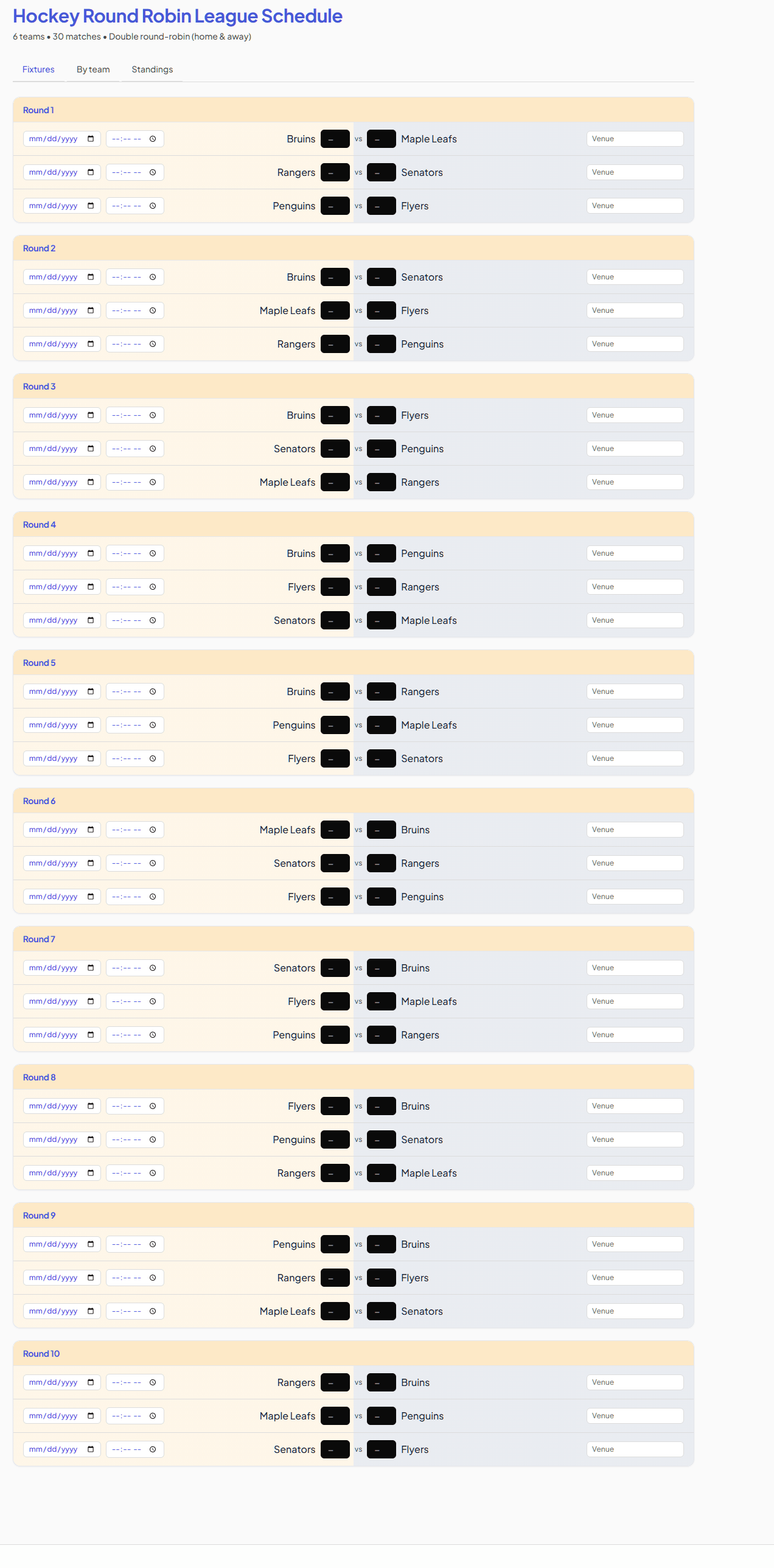
Run a hockey league season the proper way: every team plays every other team across a regular season. Single round-robin for short seasons, double round-robin (home & away) for full ones.
Example schedule
At a glance
6
Teams
10
Rounds
30
Total matches
10
Matches per team
Set up as a double round-robin (home & away) . Each pair meets 2 times.
Scoring
Default: 2 points for a win, 1 for a draw. Matches NHL-style regulation scoring. Many leagues add overtime/shootout points; adjust under Schedule options.
Preview
Schedule preview
The first 12 fixtures using sample team names. Open the editor to rename teams, enter scores, and add dates.
| Round | Match | Home | Away |
|---|---|---|---|
| 1 | 1 | Bruins | Maple Leafs |
| 1 | 2 | Rangers | Senators |
| 1 | 3 | Penguins | Flyers |
| 2 | 1 | Bruins | Senators |
| 2 | 2 | Maple Leafs | Flyers |
| 2 | 3 | Rangers | Penguins |
| 3 | 1 | Bruins | Flyers |
| 3 | 2 | Senators | Penguins |
| 3 | 3 | Maple Leafs | Rangers |
| 4 | 1 | Bruins | Penguins |
| 4 | 2 | Flyers | Rangers |
| 4 | 3 | Senators | Maple Leafs |
Planning the season
Planning a hockey league schedule
Ice per game
~90 min including floods
Typical league
6–12 teams
Scoring
2-1-0, or the 3-2-1 overtime system
Tiebreaker
Goal differential, then goals for
Hockey round-robins are built around ice time, and ice time is bought in fixed slots. A game plus the flood either side is about ninety minutes of a sheet, so a rink with a four-hour evening block runs two or three games. That is the number that decides your season length: a twelve-team league playing a single round-robin is 66 games, which is more than twenty evenings at three a night.
Double round-robin — home and away — is the norm wherever teams have a home rink, because the draw has to be even on ice allocation as well as on fixtures. Where everybody plays in the same building, single round-robin plus a playoff is more common and the home-and-away label just decides which bench and which jerseys.
Scoring is where hockey differs from everything else: the usual table is two points for a win, one for a tie or an overtime loss, zero for a regulation loss, and goal differential as the first tiebreaker. Leagues that have moved to the three-point game give three for a regulation win, two for an overtime win and one for an overtime loss. Both are supported; what matters is deciding before the season which one the standings use, because they produce different champions.
With an odd number of teams, one sits out each round. In a rink-slot league that is a free week rather than a wasted booking, so it is worth building the schedule around the slots you actually hold and letting the bye fall on the week you are short a sheet.
FAQ
Frequently asked questions
How many games in a hockey round-robin?
N × (N − 1) ÷ 2 single, double that for home and away: 28 games for 8 teams single and 56 home-and-away, 66 and 132 for 12. At two or three games per evening slot, plan the season from the games rather than the weeks.
What points system should I use?
Two for a win, one for a tie or overtime loss, zero for a regulation loss is the traditional table. The three-point game (3 for a regulation win, 2 for an overtime win, 1 for an overtime loss) rewards winning in sixty minutes. Pick one before the season — they rank the same results differently.
Should the league be home and away?
Yes if teams have their own rinks, because the draw then balances ice allocation as well as fixtures. If everyone plays in one building, a single round-robin plus a playoff is cheaper and the home side just picks the bench.
How do I build the schedule around ice slots?
Enter your slots as the round dates and let the bye fall on a week where you are a sheet short. Assigning venues also lets the generator flag two games booked on the same sheet at the same time.
Can I track goal differential?
Yes. Enter the score of each game and the standings keep goals for, goals against and differential, with differential as the first tiebreaker by default.
Other sports
Ready to make your real schedule?
Open the editor pre-filled for this format. Rename teams, set dates, print or export.
Open editor