Sport template
Tennis Round Robin League Schedule
Set up a tennis round-robin for your club, ladder, or local league. Add singles players or doubles teams, generate a balanced schedule, and record results match by match.
Example schedule
At a glance
4
Teams
3
Rounds
6
Total matches
3
Matches per team
Scoring
Default: 1 point per match win, no draws. For set-based scoring, switch to point-per-set under Schedule options.
Preview
Schedule preview
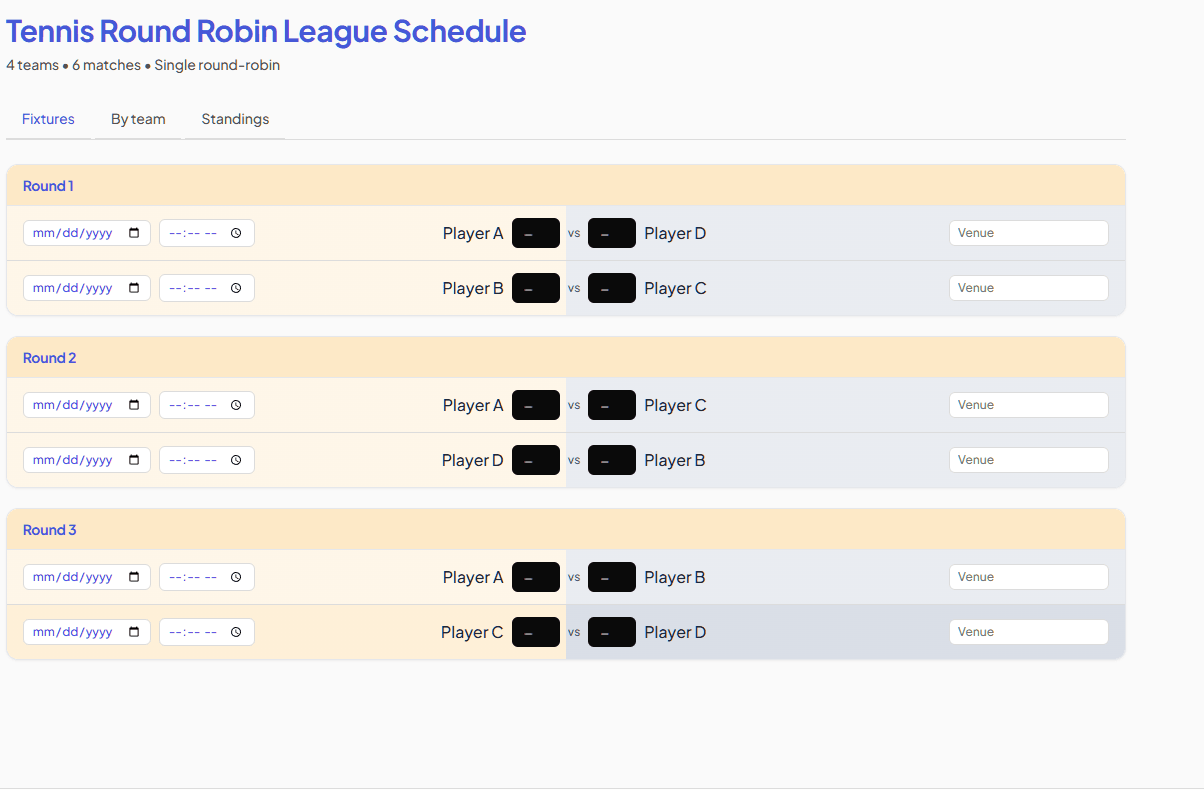
The first 6 fixtures using sample team names. Open the editor to rename teams, enter scores, and add dates.
| Round | Match | Home | Away |
|---|---|---|---|
| 1 | 1 | Player A | Player D |
| 1 | 2 | Player B | Player C |
| 2 | 1 | Player A | Player C |
| 2 | 2 | Player D | Player B |
| 3 | 1 | Player A | Player B |
| 3 | 2 | Player C | Player D |
Planning the season
Running a tennis round-robin or club ladder
Box size
4–5 players (6 or 10 matches)
Block length
4–6 weeks, players arrange their own times
Scoring
1 per win, then sets won, then games won
Unplayed matches
Set the rule before the block starts
A tennis round-robin is the fairest way to run a club box league, and it is usually run as a 'box': four or five players who all play each other over a month, with promotion and relegation between boxes at the end. Four players is six matches, five is ten — few enough that everybody can arrange their own court time rather than you scheduling it.
Which is the point. Tennis matches take between one and three hours and both players have to agree a time, so the schedule is a list of fixtures to be played by a deadline, not a fixed timetable. Print the grid, pin it up, and let players tick off results as they go. What the generator gives you is the complete list of who owes whom a match, which is the thing that otherwise gets lost.
Scoring: one point per win is standard for boxes, with sets won then games won as tiebreakers. Some clubs give a point for a lost match that went to a deciding set, which gets more dead rubbers played. If a match is not played by the deadline, decide in advance whether it is a double default or whether the player who tried to arrange it takes the win — that single rule prevents most box-league arguments.
For a one-day event, a round-robin group guarantees everyone three or four matches instead of the single match a knockout gives the first-round losers. Four groups of four, winners into a semi-final, fits a day on four courts with short sets.
FAQ
Frequently asked questions
How do I set up a tennis box league?
Split the club into boxes of four or five by standard, run a full round-robin inside each box over four to six weeks, then promote the winner and relegate the bottom player for the next block. Four players is six matches and five is ten, which players can arrange themselves.
How many matches will each player get?
N − 1 in a single round-robin: three matches in a box of four, four in a box of five. Double it if the box plays everyone twice, which some clubs do over a longer block.
How do I rank players who finish level?
Matches won, then sets won, then games won. Head-to-head is a reasonable first tiebreaker in a box small enough that everyone has played everyone. Publish the order with the grid so it is settled before anyone needs it.
What about matches nobody plays?
Decide the rule up front: either a double default with no points to anyone, or a win to the player who can show they offered dates. Leaving it unwritten is what turns a box league into an argument.
Does it work for doubles?
Yes. Enter each pair as one entry and the round-robin pairs them like singles players. For a rotating-partner social event, enter individuals and rank on total games won instead of match record.
Other sports
Ready to make your real schedule?
Open the editor pre-filled for this format. Rename teams, set dates, print or export.
Open editor