Sport template
Pickleball Round Robin League Schedule
Run a pickleball round-robin in minutes. Add players or doubles teams, choose a single or double round-robin, and let My Bracket App handle the pairings. The standings table updates as you enter scores. Perfect for ladder leagues and club tournaments.
Example schedule
At a glance
6
Teams
5
Rounds
15
Total matches
5
Matches per team
Scoring
Default: 1 point per win, no draws (most pickleball formats play first-to-11 with no ties). Switch to points-per-match if your league uses it.
Preview
Schedule preview
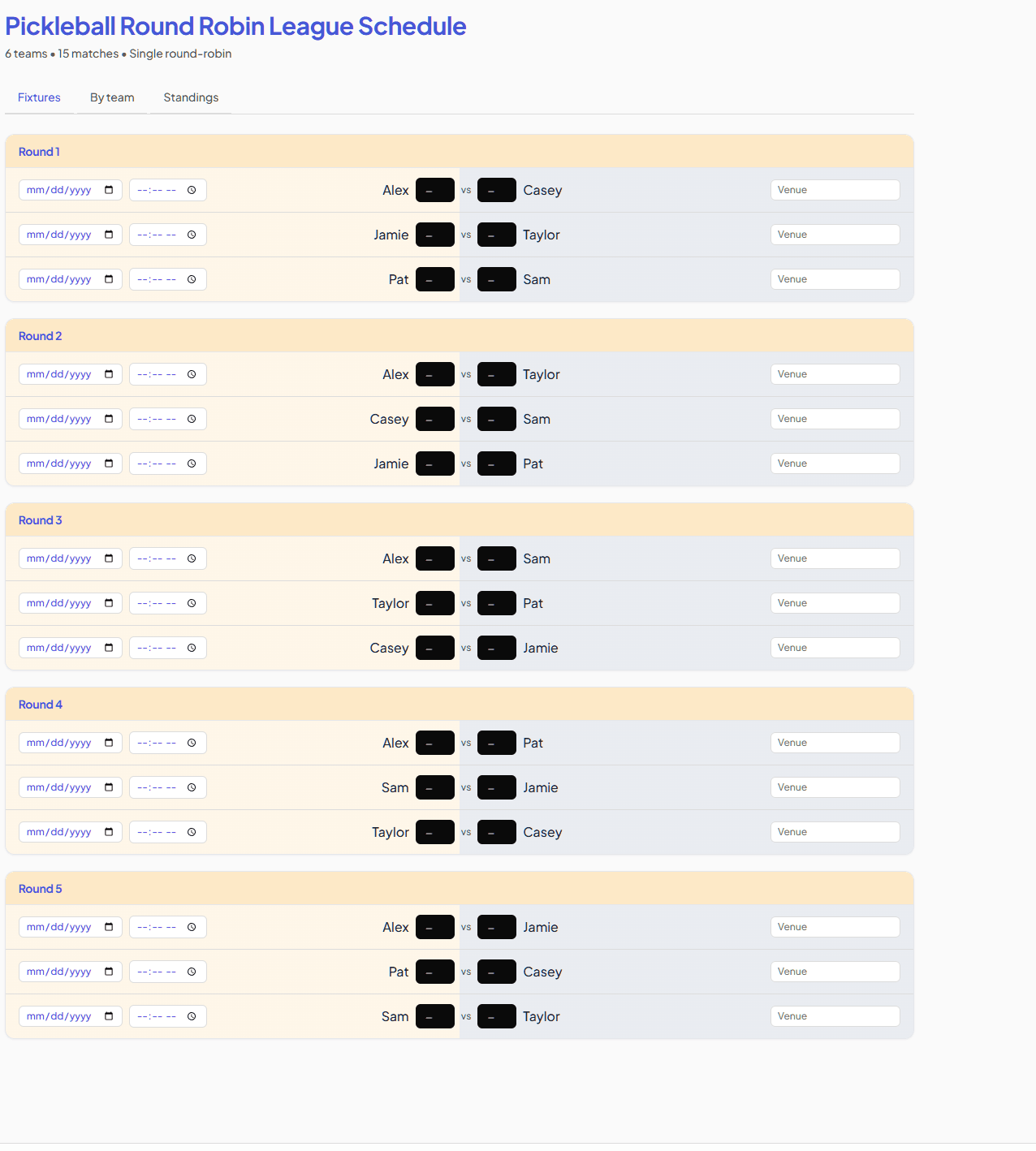
The first 12 fixtures using sample team names. Open the editor to rename teams, enter scores, and add dates.
| Round | Match | Home | Away |
|---|---|---|---|
| 1 | 1 | Alex | Casey |
| 1 | 2 | Jamie | Taylor |
| 1 | 3 | Pat | Sam |
| 2 | 1 | Alex | Taylor |
| 2 | 2 | Casey | Sam |
| 2 | 3 | Jamie | Pat |
| 3 | 1 | Alex | Sam |
| 3 | 2 | Taylor | Pat |
| 3 | 3 | Casey | Jamie |
| 4 | 1 | Alex | Pat |
| 4 | 2 | Sam | Jamie |
| 4 | 3 | Taylor | Casey |
Planning the season
Running a pickleball round-robin
Game length
15–20 min to 11, win by 2
Court throughput
~2 games per court per hour
Pool size
5–8 players or pairs
Scoring
1 point per win, or rank on point differential
Pickleball round-robins are short, fast and usually finished in one session, which makes court count the thing that matters. A game to eleven takes fifteen to twenty minutes, so a four-court club can clear eight games an hour. An eight-player singles round-robin is 28 games — about three and a half hours on four courts, which is a normal club morning.
Decide whether you are running fixed partners or a rotating ladder, because they are different events. Fixed doubles pairs enter as one entry and the round-robin pairs them like any team. A rotating round-robin reshuffles partners every round so everybody plays with and against everybody — that is the social format, and it ranks individuals rather than pairs, which means you score on total points won rather than match record.
For fixed pairs, one point per win and no draws is the simple default; games to eleven win by two cannot tie. Many clubs rank on point differential instead so that a 11-9 loss counts for more than an 11-1 one, which keeps the last few games of a dead match worth playing. Either works, but write it on the sheet before the first serve.
Odd numbers give you a bye each round, and in pickleball that is genuinely useful — the sitting player keeps score or feeds the next court. If you have more players than courts can handle in a session, run pools of five or six and play the top two from each in a short bracket.
FAQ
Frequently asked questions
How many games in a pickleball round-robin?
N × (N − 1) ÷ 2: ten games for 5 players, 15 for 6, 28 for 8. At two games per court per hour, an eight-player round-robin takes about three and a half hours on four courts.
Fixed partners or rotating partners?
Fixed pairs enter as a single entry and the round-robin treats them as a team, so the standings rank pairs. A rotating format reshuffles partners each round so everyone plays with everyone — rank those on total points won, not on match record, because no two players have the same partners.
How should I score a club round-robin?
One point per win is simplest and there are no draws. Ranking on point differential instead keeps lopsided games meaningful and separates players who finish on the same record. Pick one and print it on the sheet.
How many players fit in one session?
Count your courts. Four courts and a three-hour window is roughly 24 games, so six to eight entries in a full round-robin. More than that, split into pools of five or six and run a short playoff between the pool winners.
Can I use it for a ladder league?
Yes. Run the round-robin to set the ladder, then reseed from the final standings for the next block. Each block prints as its own sheet so the bulletin board always shows the current ladder.
Other sports
Ready to make your real schedule?
Open the editor pre-filled for this format. Rename teams, set dates, print or export.
Open editor