Guide
Round-robin generator: how it works
A round-robin generator is a tool that takes a list of teams and pairs them so every team plays every other team — once in a single round-robin (the standard weekend-tournament format), twice in a double round-robin (the standard for season-long leagues, played home and away). The generator runs the pairing algorithm in a fraction of a second, balances the fixtures across rounds, and rotates a bye when the team count is odd. Here is how it works under the hood, how to use it, and when it is the right pick.

Senior Sports Journalist & Match Analyst · Updated May 31, 2026
The math the generator does for you
For N teams in a single round-robin, the generator produces:
- Total matches:
N × (N − 1) ÷ 2— 6 teams = 15 matches, 8 teams = 28, 12 teams = 66, 20 teams = 190. - Number of rounds: N − 1 with an even count, N with an odd count (the extra round absorbs the bye rotation).
- Matches per round: N ÷ 2 with an even count, (N − 1) ÷ 2 with an odd count (one team byes).
- Matches per team: N − 1 in a single round-robin, 2(N − 1) in a double round-robin.
For a double round-robin, multiply matches and rounds by two. A 20-team double round-robin (the Premier League shape) is 380 matches across 38 rounds per team.
How the algorithm pairs the teams
The generator uses the circle method: line up the teams in two rows, fix one team in place, and rotate the rest around it round by round. Every rotation produces a fresh set of pairings, and after N − 1 rotations every pair has met exactly once. The method has been used since the 19th century because it is provably balanced — no team plays too often in any one round, and the home/away alternation falls out naturally.
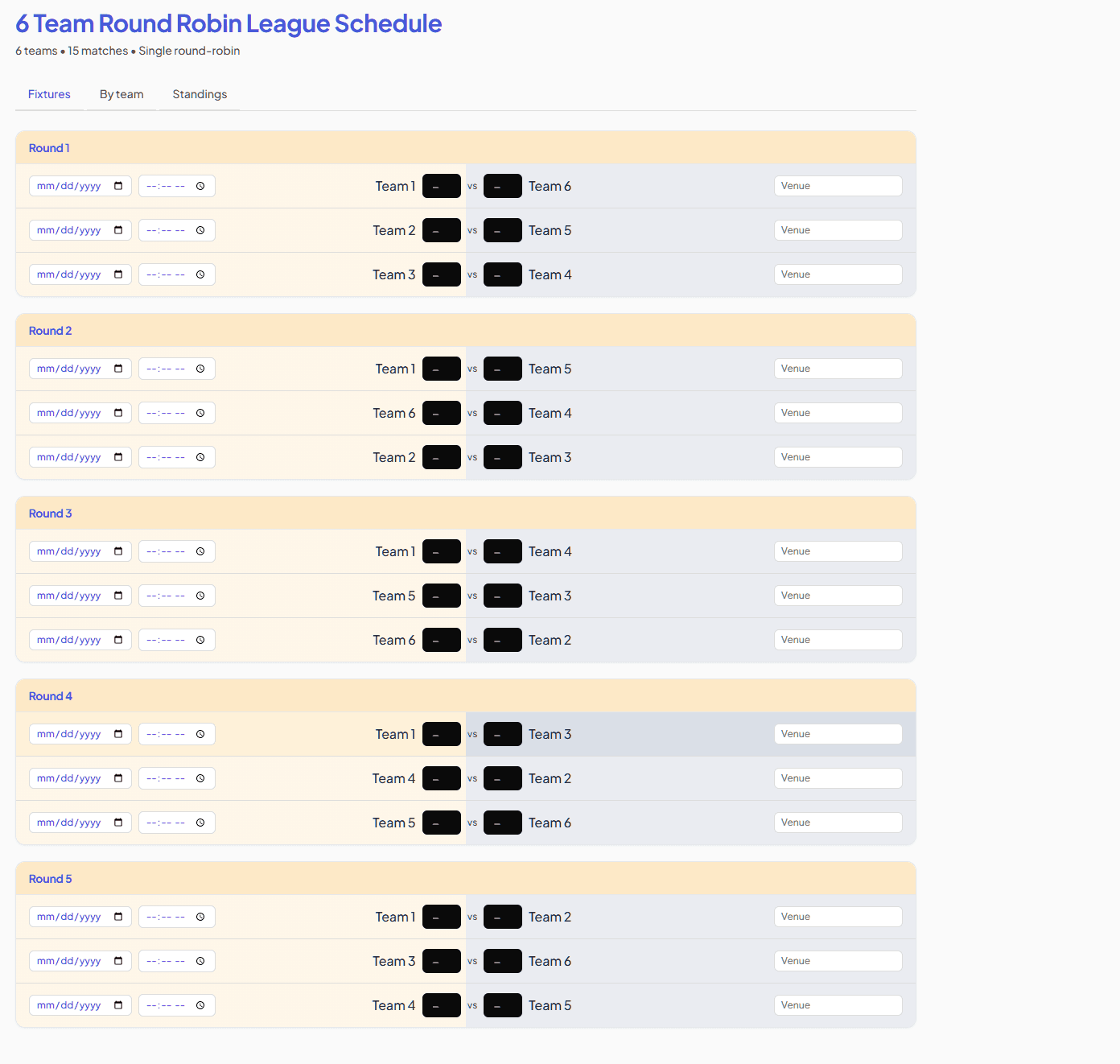
Here is the full output for six teams (A through F), built by the circle method:
| Round | Match 1 | Match 2 | Match 3 |
|---|---|---|---|
| 1 | A vs F | B vs E | C vs D |
| 2 | A vs E | F vs D | B vs C |
| 3 | A vs D | E vs C | F vs B |
| 4 | A vs C | D vs B | E vs F |
| 5 | A vs B | C vs F | D vs E |
Five rounds, fifteen matches, every pair plays once. The generator does the same thing for any team count up to 24 in a fraction of a second.
Odd team counts get a rotating bye
With an odd number of teams, perfect pairing in a single round isn't possible — one team sits out. The generator inserts a virtual “bye” team into the rotation, so the team sitting out moves cleanly through the schedule. Across the cycle, every team byes exactly once. A 7-team round-robin runs 7 rounds with 3 matches plus one bye per round; a 9-team runs 9 rounds with 4 matches plus a bye.
Round-robin generator vs bracket generator
A bracket generator builds a knockout — one loss eliminates a team and the tournament finishes in log₂(N) rounds. A round-robin generator runs the long way: every team plays every other, and the standings table at the end reflects overall performance, not one bad day. Use a bracket when time is the constraint and a single elim wallchart is what people want; use a round-robin when fairness matters more than speed.
Many real tournaments use both. The World Cup, the Champions League, and most pickleball events run a round-robin group stage and then a knockout playoff. Generate the group stage in the round-robin generator, then carry the top finishers into a single-elim bracket from the templates.
Using the round-robin generator
1. Add teams
Type team names one per line, or paste a roster. The generator handles any count from 3 to 24. Use placeholders if final names are not in yet — you can rename inline after the schedule generates.
2. Pick single or double round-robin
Single for a one-day or weekend tournament, double for a full season played home and away. The math doubles cleanly: double round-robin = 2 × matches and 2 × rounds.
3. Hit Generate
The fixtures land instantly. The generator outputs the round-by-round pairings, the bye when the count is odd, and a standings table that will populate as scores come in. Regenerate if you want a different round order — the pairings stay the same.
4. Track scores, print, share
Type the final score after each match. Standings sort by points → difference → for. Print the schedule and standings any time, or share the live URL.
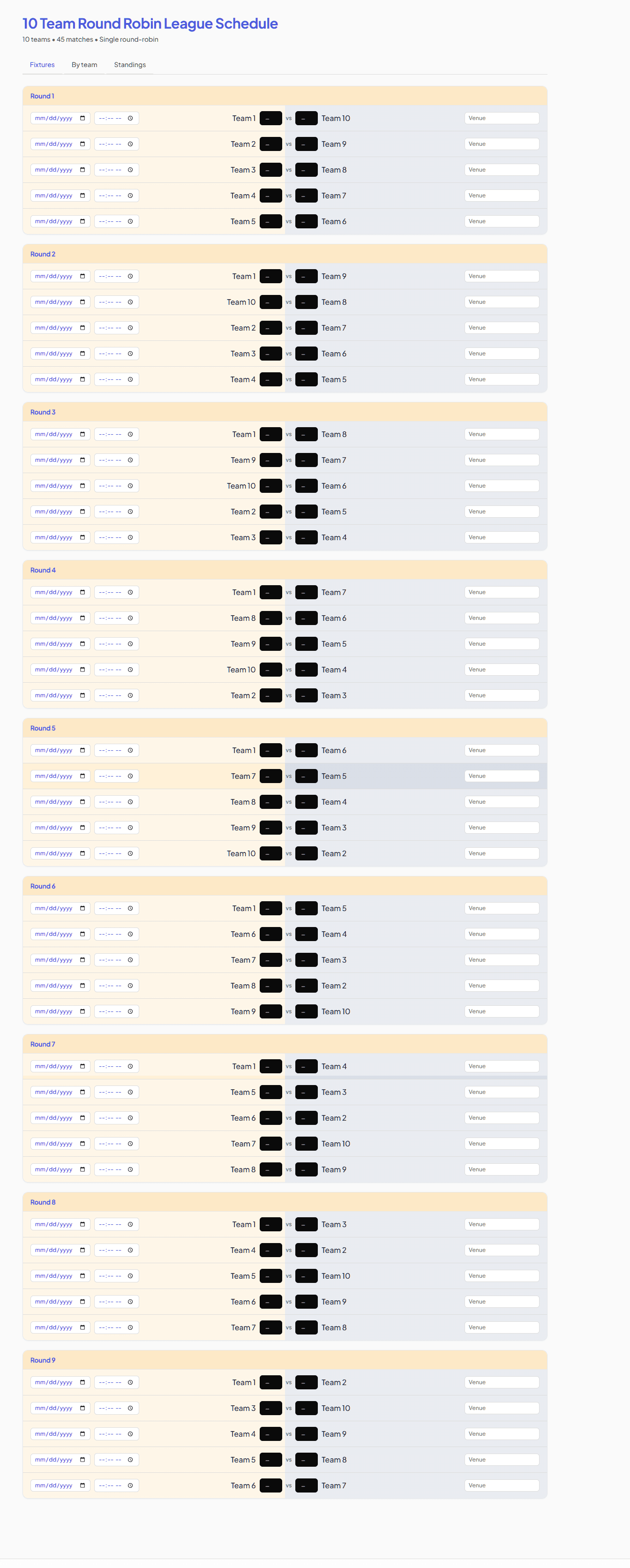
Another example
Where this fits next to the other guides
- This page covers the generator: what it is, the algorithm, and how to use it for any round-robin.
- What is a round-robin league? covers the format itself — the rules and tiebreakers.
- How to make a league schedule is the season-long companion — full league setup with scoring, gotchas, and use cases.
- Round-robin league calculator is the bare math: enter a team count, get the matches / rounds / byes.
Open the round-robin generator
Add teams, pick single or double, hit Generate. The schedule and the standings handle themselves. Free, no signup.