Guide
How to make a league schedule
A league schedule generator is a tool that turns a list of teams into a complete round-robin season — every fixture paired, rounds balanced, byes rotated, standings tracking themselves as you enter scores. The hard math of pairing N teams over N − 1 rounds without anyone playing twice in the same week is done for you in a fraction of a second. Here is how to use one end-to-end.

Senior Sports Journalist & Match Analyst · Updated May 31, 2026
What a league schedule generator does
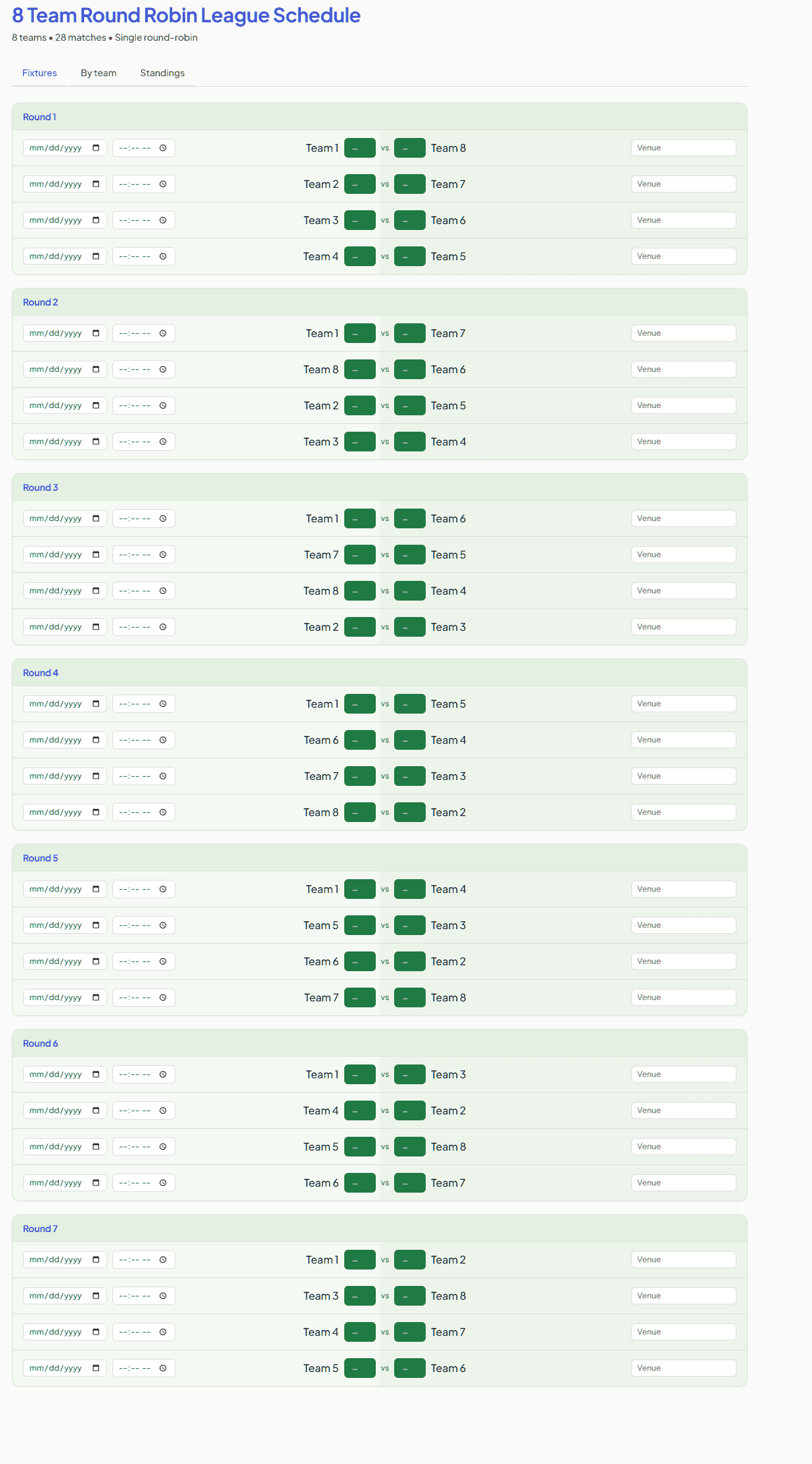
For N teams in a single round-robin, there are N × (N − 1) ÷ 2 matches to pair, and they need to spread across N − 1 rounds so no team plays twice in the same round. Doing this by hand for 6 teams is easy; for 12 it is painful; for 20 it is a Saturday afternoon. The generator runs the rotation algorithm (used by professional leagues for a century) and produces a clean, balanced fixture list instantly.
On top of pairing, a good generator tracks standings as scores come in, handles odd team counts with a rotating bye, supports double round-robin (home and away), and exports a clean printable schedule for the bulletin board.
The five steps
- 1
Add your teams
Type the names one per line, or paste a roster. Six to twelve teams is the sweet spot for most rec leagues. Below four, a round-robin runs too short to be interesting; above twenty, the season gets long. The generator handles any count from 3 to 24.
Tip: If you do not have final names yet, use placeholders. You can rename inline after the schedule generates.
- 2
Pick single or double round-robin
Single round-robin: every pair plays once. Total matches = N × (N − 1) ÷ 2. Eight teams = 28 matches. Double round-robin: every pair plays twice (usually home and away). Matches double. Eight teams = 56 matches. Choose double if the season is long enough or you want a true 'home advantage' read.
Tip: The Premier League, La Liga, MLS, and most national football leagues use double round-robin. Weekend club leagues usually use single.
- 3
Set the scoring
Default is 3 points for a win, 1 for a draw, 0 for a loss — the modern football standard. Change it to 2-1-0 for hockey, 1-0 for sports with no draws (tennis, pickleball, baseball), or anything custom under Schedule options. The standings sort by points → goal/point difference → goals/points for.
Tip: Custom tiebreakers (head-to-head, away goals) are set per league. The defaults work for 90% of cases.
- 4
Generate the schedule
Hit Generate. The fixtures land instantly, paired by the standard round-robin rotation algorithm so every team gets balanced opponents and rest. With an odd number of teams, one team gets a rotating bye each round and the bye moves cleanly through the cycle — every team sits out exactly once.
Tip: Hit Generate again if you want a different fixture order. The pairings stay the same; the round order shuffles.
- 5
Track scores as the season runs
Enter the final score after each match. The standings re-sort automatically. Goal difference, goals for, and goals against all calculate as you type. Print the standings table any time, or share the link in the league chat for everyone to see live.
Tip: Scores save locally in your browser and to your dashboard if you make an account. There is no manual recalculation.
Common gotchas
Odd number of teams = one bye per round
Perfect pairing needs an even count. With an odd number, one team sits out each round. The bye rotates — every team byes exactly once across the cycle, so nobody gets short-changed. The schedule still finishes in N rounds (instead of N − 1) and every team plays N − 1 matches.
Single round-robin with 12 teams is 66 matches
The formula is N × (N − 1) ÷ 2. With 12 teams that is 66 matches over 11 rounds. Plan two-and-a-half months at one round per week, or fit it into a season by playing two rounds per week.
Double round-robin is exactly twice as many matches
11 rounds becomes 22, 66 matches becomes 132. Most domestic football leagues use double round-robin and run for nine months — the 38-game Premier League season is a 20-team double round-robin (20 × 19 = 380 / 2 = 190 matches per club ÷ 2 venues = 38 per team).
Home-and-away balance
In a double round-robin, every team plays every other team once home and once away — it is automatic, no balancing needed. In a single round-robin, the home/away split is set by the generator and may not be perfectly even. For most rec leagues this does not matter; for a pub-darts double-leg format it is worth checking.
When you would use one
Weekend sports club
Eight teams, single round-robin, 28 matches across seven rounds. Fits in a weekend if you play multiple games per court.
Sunday football league
Ten teams, single round-robin, 45 matches over nine weeks. Add a playoff bracket for the top four to crown a champion.
Bowling or darts league
Six to twelve teams, double round-robin, two points per win and one per draw. Played over the autumn / winter season; standings rolled over to a knockout finale.
School or work league
Four to six teams, single round-robin during lunch breaks. Short and decisive — every team plays everyone else once, the top of the table wins.
Group stage of a tournament
Sixteen teams in four groups of four. Each group plays a single round-robin; the top two from each group advance to a 16-team knockout (the World Cup format).
Build your league
Drop in your teams, pick single or double round-robin, hit Generate. The schedule and the standings handle themselves.