Learn
What is a football formation?
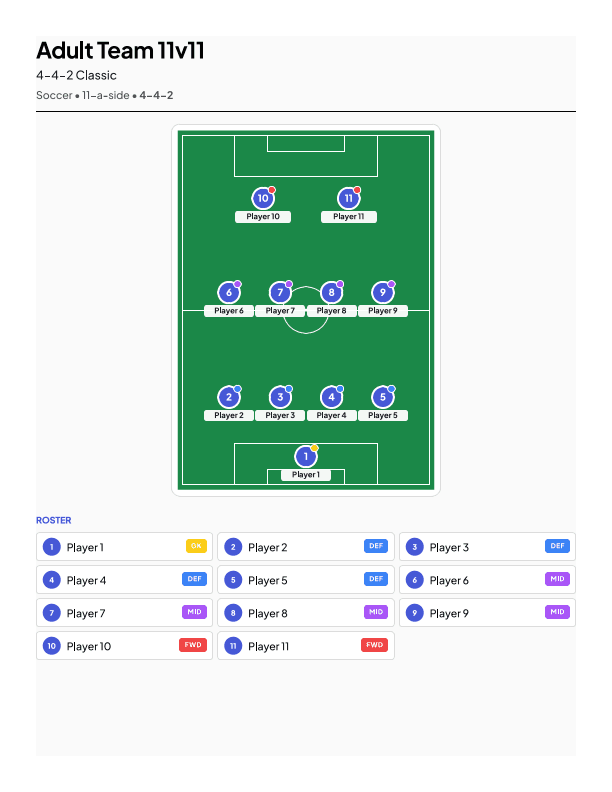
A football formation is the arrangement of players on the pitch at kickoff, written as a string of numbers (4-4-2, 4-3-3, 3-5-2) that count players in each line from defence to attack. The goalkeeper is never included in the numbers — they're always behind the back line. The formation tells you the team's shape and starting roles; tactics, pressing triggers, and attacking patterns are layered on top.

Senior Sports Journalist & Match Analyst · Updated May 31, 2026
Reading the numbers
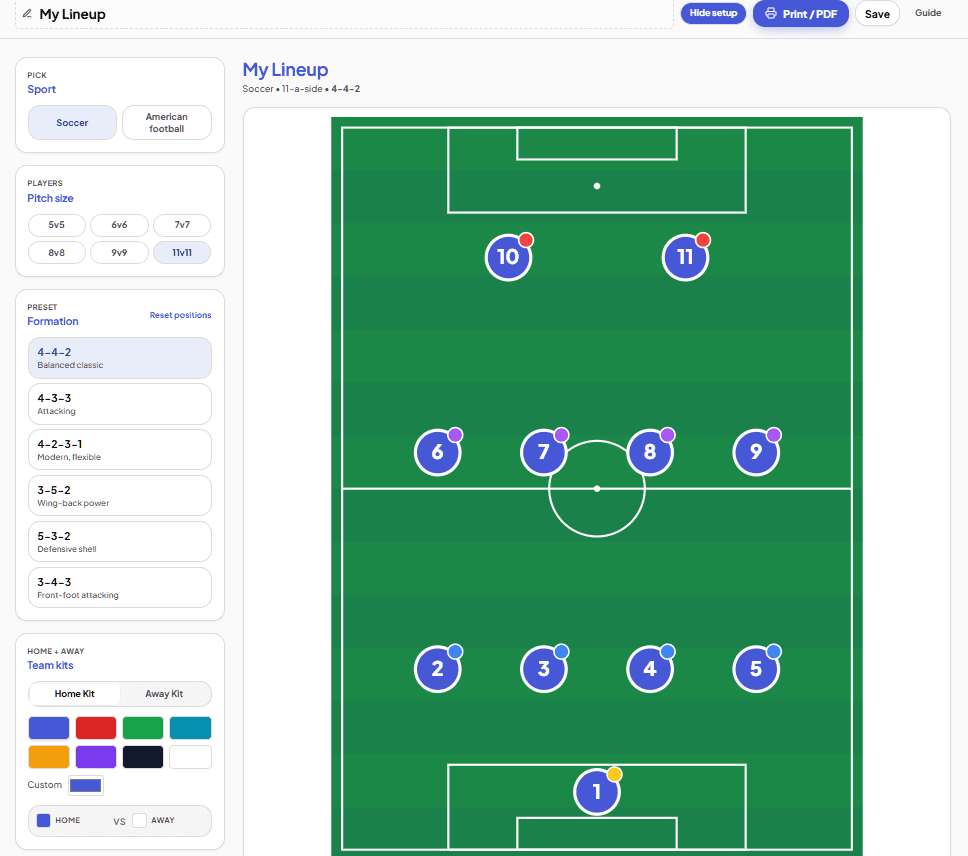
The numbers run from back to front. 4-4-2 means four defenders, four midfielders, two strikers. 4-3-3 means four defenders, three midfielders, three forwards. When the midfield splits into a holding band and an attacking band, the shape gets a hyphen and an extra number: 4-2-3-1 = four defenders, two holders, three attacking midfielders, one striker. Sum the numbers and you should get the outfield count (10 for 11-a-side, 8 for 9v9, and so on).
The goalkeeper is implied.They're always at the back and don't count in the formation string. That's why every 11v11 formation adds up to 10 outfielders.
Common 11-a-side soccer formations
| Shape | Lines | What it's good for |
|---|---|---|
| 4-4-2 | 4 defenders, 4 midfielders, 2 strikers | The classic balanced shape. Two banks of four, two strikers. Forgiving for under-coached sides because everyone's role is unambiguous. |
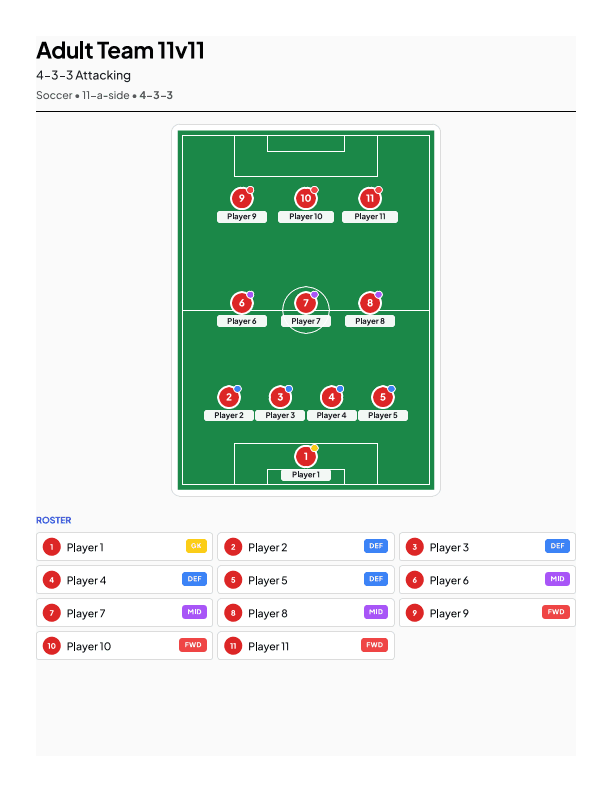
| 4-3-3 | 4 defenders, 3 midfielders, 3 forwards | Width up front. Two wingers stretch the back four; three central midfielders win the middle. Klopp / Guardiola staple. |
| 4-2-3-1 | 4 defenders, 2 holding midfielders, 3 attacking midfielders, 1 striker | Modern default. Two holders give cover; a number-10 plays between the lines; wingers cut inside off a lone striker. |
| 3-5-2 | 3 centre-backs, 2 wing-backs, 3 central midfielders, 2 strikers | Wing-backs do all the running. Strong if the wing-backs are athletic and the centre-backs can pass out. |
| 5-3-2 | 5 defenders (wing-backs drop back), 3 midfielders, 2 strikers | Same personnel as 3-5-2, more defensive shape. Used to protect a lead or against a stronger side. |
| 3-4-3 | 3 centre-backs, 4 midfielders, 3 forwards | Aggressive front-foot pressing. Wing-backs higher than wing-mids; centre-backs spread to cover the channels. |
Small-sided formations
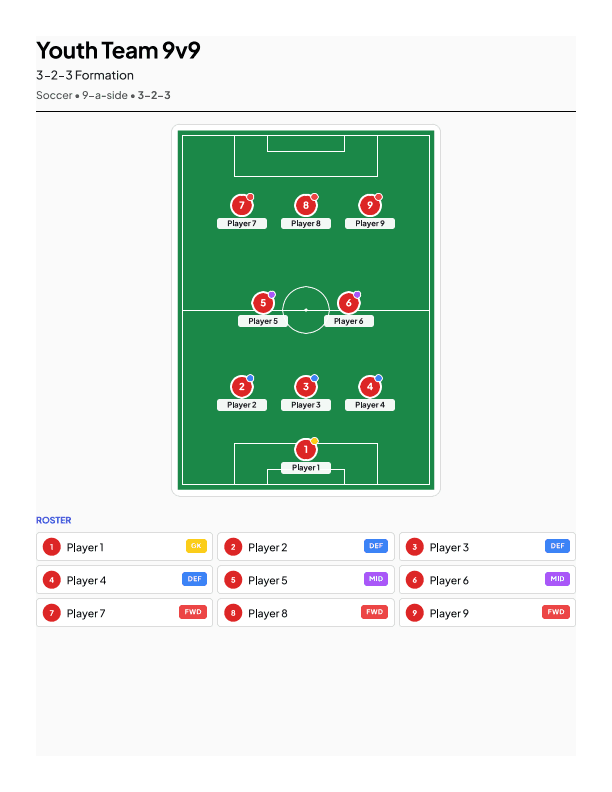
Youth football and small-sided adult leagues use the same notation with smaller numbers. The principle is the same — count lines from back to front, outfield only, GK implied. The most-used shapes by pitch size:
- 5-a-side (5v5): 1-2-1 diamond, 2-1-1 defensive, 1-1-2 attacking. Outfield count is 4.
- 6-a-side (6v6): 2-2-1 standard. Outfield count is 5.
- 7-a-side (7v7): 2-3-1 possession, 3-2-1 defensive, 2-2-2 balanced. Outfield count is 6.
- 8-a-side (8v8): 3-2-2 balanced, 2-3-2 diamond. Outfield count is 7.
- 9-a-side (9v9): 3-2-3 balanced (the youth standard), 3-3-2 midfield-heavy, 2-4-2 wing-focused. Outfield count is 8.
American football is a different language
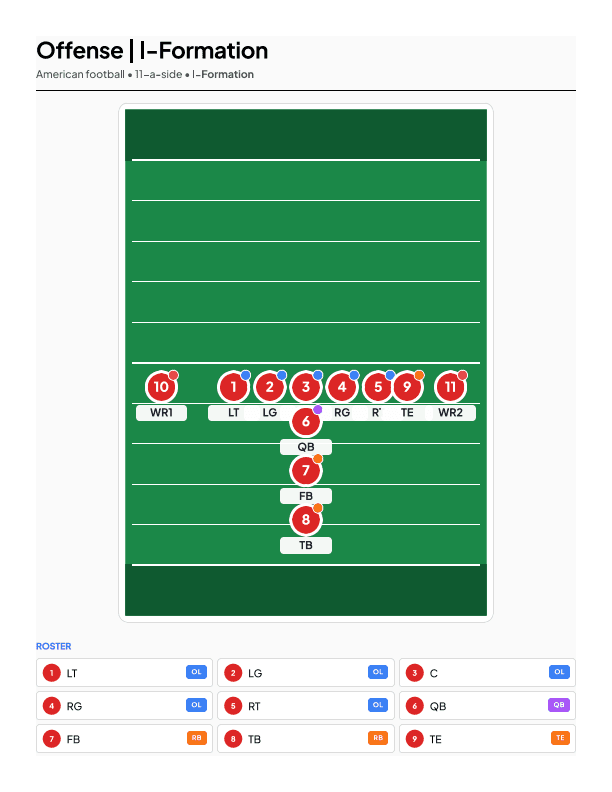
Gridiron formations have personnel groupings (offense vs defense), not back-to-front numbers. On offense the line is always five linemen, plus a quarterback. The variable pieces are running backs, tight ends, and receivers. Common offensive formations:
- I-Formation: Two backs stacked behind the QB — fullback in front, tailback behind. Power-running base.
- Shotgun Spread: QB starts 5 yards behind the centre, three or four receivers split wide. Modern passing base.
- Pistol: QB at ~4 yards back, running back directly behind. Hybrid of I-Form and Shotgun.
On defense the numbers come back, but they count front-seven personnel: 4-3 is four linemen and three linebackers, 3-4is three linemen and four linebackers. Defensive backs (cornerbacks + safeties) aren't in the formation name; they're always there.
How to pick one
Pick the formation that fits your players, not the one you wish you could play. A 4-3-3 needs two genuine wingers; a 3-4-3 needs centre-backs who can pass out under pressure; a 4-4-2 needs two strikers willing to defend from the front. For youth sides, the balanced shapes (3-2-3 at 9v9, 2-3-2 at 8v8) develop every player on the pitch and avoid pigeonholing kids into specialist roles too early.
Build your own formation
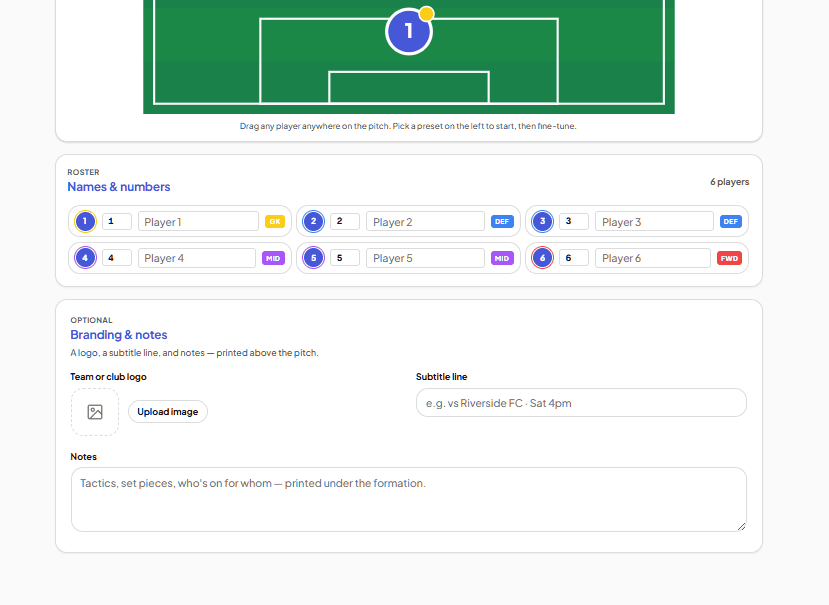
The free formation creator picks the right pitch markings for soccer or American football, drops your players into a preset with one click, lets you drag positions to fine-tune, names the roster, and prints a clean team sheet you can pin in the dressing room.